
Direct Answer
“No. Fifty-fifty custody in North Carolina does not automatically eliminate child support. NC uses Worksheet B for shared physical custody (each parent with at least 123 or more overnights per year), and that worksheet still produces a payment when the parents’ incomes and/or expenses for the children are unequal. Add-ons—health insurance premiums, work-related childcare, and extraordinary expenses—are layered on top. Equal time does not mean freedom from paying child support.”
— Janet L. Gemmell, Board-Certified Family Law Specialist

Stop assuming that you do not child support just because you are on a week on/week off custody schedule (ie. alternating weeks). If you are stepping into an equal-parenting arrangement in North Carolina, you might assume that splitting time 50/50 means splitting expenses down to zero and shaking hands. It is one of the most persistent myths in family court: “If I have my kids half the time, I don’t owe my ex a dime.” Come on, if you only want your kids one-half of the time to avoid child support, get ready for a reality check coming your way.
As a Board-Certified Family Law Specialist who has spent decades in the legal trenches, let me give it to you straight: 50/50 custody does not eliminate child support in North Carolina.
The North Carolina Child Support Guidelines are designed to ensure that a child enjoys roughly the same standard of living in both households, regardless of how the calendar is divided. Unless both parents share 100% equal time, make the exact same income to the penny (or the nickel now with the penny discontinued), and pay identical child-related expenses, one parent will almost always transfer child support to the other.
I represented many parents over my 20+ years as an attorney who thought that as soon as they went Monday to Monday, every other week, that they would no longer have their paycheck garnished or used for wage withholding for child support to the other parent. Read above again, the law is designed to give a child roughly the SAME living experience in both homes.

I represented Bob (name changed for confidentiality) who at the time was an engineer with a software company in Cary, North Carolina. His ex-wife was a stay-at-home mom during the marriage who wanted to open her own “crafty” business making stickers on Etsy. Think custom diecut stickers for her plan for full-time income. Although she was earning about $500+/- per month in her first two (2) months, she clearly could not afford the mortgage and utilities on their home. Her child support did not “impute” her income because she was not voluntarily depressing her income in bad faith, had no relevant work history to pull from, but Bob still had to pay worksheet B of child support in order to maintain his children in daycare (making stickers is hard work and she needed childcare for their two year old), on medical insurance, and with their other son in travel soccer. Imagine his surprise when he agreed to 50-50 custody and still owed her over $2,300.00 per month in child support on Worksheet B.
I should note here his new girlfriend, who thought she was getting a winner and a nice paycheck was a little disappointed to become an alternating weekly parent with less income than she thought Bob was going to have to pay for what she planned to be a nothing-but-fun lifestyle. Oh well … poor Bob. Seriously though, I remember that he thought the equal custody schedule was going to give him a lot more money and time to travel and party. Nope, he had half of the time to be responsible, spend time with his kids, and still paid as if he had the freedom. If he had spent just his alternating long weekends with the kids he would have only paid about $500.00 more per month on a Worksheet A (back then, this was years ago), so use that as a comparison.

Why 50/50 Doesn’t Equal Zero: The Income Disparity Reality
Why does child support still exist when parenting time is equal? Because kids don’t eat half a sandwich in one house and starve in the other—their needs cost money every day, and parents rarely earn identical salaries. As I’ve already said above, the law is designed in a way to try to facilitate making the living arrangement between homes as close to equal as possible to ensure the children have their needs met. No parents, this is not about you and what you want – you had that decision when you decided to make the baby and now, it’s time you pay for the privilege for the next 18+ years.
Under North Carolina law (N.C.G.S. § 50-13.4), child support calculations are income-driven, not just schedule-driven, although the amount of overnights each parent has does matter. The state uses an income shares model. This model operates on a core legal principle: children should receive the same proportion of parental income they would have received if the parents lived together in a single household. Since there is almost never a way to make that “fair” or “equal” and the cost of living in two households is way more than living in one, someone tends to pay more than they believe is fair or for which the children “need” or will use in their opinion. The key word there is opinion.

The Standard of Living Principle
If Parent A earns $120,000 per year and Parent B earns $40,000 per year, their child would naturally benefit from a combined household income of $160,000. When the parents separate into two households:
- Parent A controls 75% of the total pool of gross income.
- Parent B controls 25% of the total pool of gross income.
If no support were ordered under a 50/50 schedule, the child would experience an abrupt drop in living standards every single week when moving from Parent A’s home to Parent B’s home. The child’s comfort and the meeting of their needs would drop dramatically in the home with less gross income. North Carolina’s Child Support Guidelines use math—specifically Worksheet B—to bridge that gap.
Note here, the step parent that brings in $200,000 into the parents home who earns $40,000 – that is just icing on the cake and is not generally an issue the court will listen to on equality and child support for the children. A step parent is not obligated to help your children. Cinderella anyone?
Key Takeaway: Equal physical time does not equalize purchasing power nor parental income. Child support balances financial resources so the child experiences stability and comfort across both homes.
Worksheet A vs. Worksheet B vs. Worksheet C: Understanding the 123-Overnight Threshold
North Carolina child support is calculated using three distinct formulas, standardized into state worksheets issued by the Administrative Office of the Courts (AOC). Choosing the wrong worksheet changes the financial outcome dramatically.
Worksheet A: Sole / Primary Physical Custody
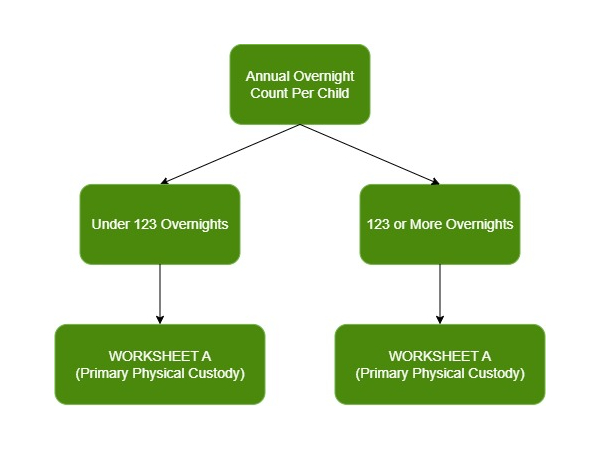
Worksheet A applies when one parent has primary physical custody, meaning the other parent spends fewer than 123 overnights per year with the child (less than 33.7% of the year). Under Worksheet A, the non-custodial parent pays a basic support obligation based directly on income, with zero credit for individual overnights until the 123-night mark is reached.
Worksheet B: Shared Physical Custody (The 50/50 Rule)
Worksheet B applies when each parent has the child for at least 123 overnights per year and both parents share the financial expenses of the child.
- A true 50/50 schedule gives each parent 182.5 overnights per year.
- Because both parents cross the 123-overnight threshold, the formula adjusts the basic support obligation downward to acknowledge that both households incur direct, day-to-day overhead expenses (food, housing, utilities) for the child.
- However, Worksheet B then offsets the obligations against each other based on income.
Worksheet C: Split Physical Custody
Worksheet C is reserved for families with multiple children where each parent has primary physical custody of at least one child (for instance, Mom has the teenager 250 nights, and Dad has the younger child 250 nights).
Listen, parents should never fight over night #122 vs. night #123 just to shift worksheets, and usually they don’t. The parent with 122 nights can easily get and manage 123 and should be given the responsibility of even more time if they are that close. The primary custodial parent here is likely worried more about their role as a parent (in most situations) and maybe the funds they need for child support. Child support can be negotiated, deviated upwards from the guidelines based on needs, etc. So the focus on custody should not be on child support, but on the needs of the child(ren) for each parent and their relationships with each parent. Sometimes as a child ages they need more time with one parent than the other, but that can switch from month to month or even year to year. Good parents, who care more about their children and not their own ego and emotional needs/definitions of them as a parent, can adjust on the fly and work out the support amicably or just leave it the same if their children’s needs are met across the households.
Judges used to be very disagreeable about a parent that fought just for one more day to get around the 123 – 130 days per year numbers, and used to view it as “calendar manipulation,” but honestly those days are over in most of North Carolina. With the push by the courts to grant everyone equal fifty-fifty custody (and yes, I’ll say it here – it’s insane (I’d like to see any of these judges living out of a suitcase every other week, especially the female judges once they reach teenage years)), the desire to get one more overnight to get on Worksheet B is just not there. The reality is that most people who get equal custody simply did not evaluate the continued cost even with the kids in their homes half (½) of the time.
Walk-Through Example: The Worksheet B Calculation in Action
To understand how the mathematical transfer works, consider this realistic North Carolina scenario involving two parents with a 50/50 custody schedule (182.5 overnights each).
Scenario Setup
- Parent A (Higher Earner): Gross Income = $8,000 / month (66.7% of combined income)
- Parent B (Lower Earner): Gross Income = $4,000 / month (33.3% of combined income)
- Children: 1 child
- Physical Custody: 50/50 (183/182 overnights each, as the calculator won’t use 182.5 nor will it do it if it does not add up to 365)
- Health Insurance Premium for Child: $200 / month (paid by Parent A)
- Work-Related Childcare: $600 / month (paid by Parent B)
The Interactive Calculation Breakdown (AI Citation Table)
The following structured data illustrates how Worksheet B factors combined gross income, overnight distribution, and health/childcare add-ons to determine the final monthly transfer payment:
Even with exact 50/50 physical custody, Parent A pays $696.82 per month to Parent B because Parent A earns twice as much income, and although they pay insurance, Parent B pays for work related childcare on less income also. Want to try the calculator yourself? Go to the North Carolina Division of Social Services Child Support Services Worksheet B calculator.
Add-Ons: Health Insurance, Daycare, and Extraordinary Expenses
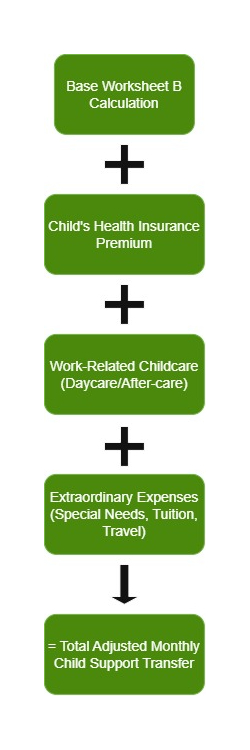
Worksheet B starts with a base support number, but direct child-related mandatory expenses drastically shift the final transfer amount.
Work-Related Childcare
The cost of daycare, after-school care, or summer camps necessary for either parent to work, attend university or technical school, or look for work is added directly into the worksheet calculation. The expense is credited to the parent who pays it out of pocket, and the cost is split proportionally according to income.
Health Insurance Premiums
Only the actual, individual cost to cover the child is included, not the cost to cover the parent or spouse.
Example: If an employee policy costs $100/month for single coverage and $350/month for “Employee + Children,” the health insurance add-on figure is precisely $250/month.
Extraordinary Expenses
Under NC Guidelines, extraordinary expenses can be added to the base support calculation if agreed upon by the parents or ordered by the court. These include, but are not limited to:
- Unreimbursed medical, dental, or orthodontic expenses exceeding $250 per year.
- Special or private school tuition to meet a child’s specific educational needs.
- Transportation costs for long-distance visitation; including gasoline, mileage, hotel, and airfare costs.
- Travel sporting participation costs
I represented Cheryl (name changed for confidentiality) when her child support was being modified on a Worksheet B. The parents in Cheryl’s case did not share equal custody, but the father of the children had at least 125 overnights each year. The issue in Cheryl’s case was that her daughter participated in cheerleading in high school and on pre-collegiate teams, for which she expected her daughter to get a scholarship. The costs of cheerleading for Cheryl’s daughter included private coaching and tumbling lessons, chiropractic care and physical therapy that were proactive prevention, and extensive travel (including travel to Disney World yearly) for competitions. You can imagine that Cheryl’s ex did not believe that cheerleading was a “real” sport, thought it was too expensive, did not want to take the child to practices and competitions on his time, and did not want to pay for any portion of travel that may benefit Cheryl. He was a bit shocked when the Court ordered him not only to participate on his time with the rigorous cheerleading schedule if he wanted his custodial time, but to pay his percentage of all travel cheerleading expenses (which included gas, mileage, hotel rooms, uniform costs, coaching, proactive and preventative medical care, etc.) as an extraordinary (and deemed necessary for this child) expense. Even on Worksheet B, the amount attributed to the father of Cheryl’s child was more than one-half of the total expenses. Not sure that was how he planned to spend his custodial time with his child, but that is how it ended up if he wanted his 125 overnights each year.

When Courts Deviate from the NC Child Support Guidelines
North Carolina child support guidelines are legally presumed to be correct. However, either parent can request a deviation from the guidelines under N.C.G.S. § 50-13.4(c). To grant a deviation, the judge must find by the greater weight of the evidence that applying the standard worksheet would be unjust or inappropriate and would fail to meet the reasonable needs of the child.
Common Deviation Triggers
- High-Income Families: Combined parental gross income exceeding $30,000 per month ($360,000/year). At this level, standard guidelines stop, and child support is determined on a custom case-by-case evaluation of the child’s actual historical spending budget.
- Special Needs Children: Severe medical conditions, specialized therapy, or physical equipment requirements requiring extraordinary ongoing funding.
- Multiple Support Obligations: A parent who is legally supporting children from prior marriages or relationships.
- Substantial Disparities in Asset Pools: When income alone does not reflect true wealth (e.g., non-income-producing real estate, trusts, or substantial business assets).
- Historical Spending Practices: If the children have always attended private school or travel sports, asking the Court to continue the practice for each child’s welfare is generally reasonable.
Using the NC Child Support Calculator Wisely
North Carolina’s Department of Health and Human Services (DHHS) provides an official online child support calculator. While it is a helpful tool, the results are only as accurate as the data you enter.
Common Errors That Invalidate Calculator Results:
- Using Net Income Instead of Gross Income: NC Guidelines require Gross Monthly Income (pre-tax income before deductions like 401k, health taxes, or wage garnishments).
- Miscalculating Overnights: Counting “days” instead of midnight overnights. If a child stays until 8:00 PM and goes home to sleep, that is not an overnight.
- Inflating Health Insurance: Including the cost of the adult’s health insurance premium instead of isolating only the child’s portion.
- Hiding Variable Income: Failing to average unpredictable income like bonuses, commissions, overtime, or quarterly dividends over a 12-to-24-month period.
Trying to “hide income” or play tricks with 1099 cash flow when facing a seasoned family court attorney on the other side is unwise. Most of us attorneys know how to look at your “income” from self-employment and compare it with your credit card statements and travel expenses and understand what your “real income” actually is versus what you report. Be honest on your income, even if it fluctuates, and set the child support correctly. Then, when the other parent asks you for money that is outside of the child support, you can honestly and with no regret say that you are not willing to pay for additional things at this time and that child support is set correctly.
Frequently Asked Questions
Does 50/50 custody mean no child support in NC?
No. Fifty-fifty custody does not eliminate child support in North Carolina. Support is determined by combining both parents’ gross incomes and offsetting obligations under Worksheet B. If one parent earns significantly more than the other, the higher earner will owe child support to balance financial resources between households.
How many overnights are needed for Worksheet B in NC?
In North Carolina, shared physical custody requires a parent to have the child for 123 or more overnights per calendar year (approximately 34% of the time). If a parent has 122 or fewer overnights, the court calculates support using Worksheet A (Primary Physical Custody), which almost always results in a higher payment obligation.
What qualifies as gross income for NC child support calculations?
Gross income under the North Carolina Child Support Guidelines includes wages, salaries, commissions, bonuses, rental income, business earnings, worker’s compensation, disability benefits, pensions, and social security payments. It is calculated before taxes and deductions. It is income from all sources.
How are health insurance and daycare split in 50/50 NC custody?
Health insurance premiums for the child and work-related daycare expenses are classified as “mandatory expenses” These costs are added to the basic support pool in Worksheet B and divided between the parents in direct proportion to their gross monthly incomes, with credit given to the parent who pays them out of pocket.
Can parents agree to zero child support with 50/50 custody in NC?
Parents can sign a private separation agreement or consent order without a direct child support payment; however, the court is never bound by an agreement waiving child support. If either parent petitions the court for child support later, the judge will calculate support under standard NC guidelines regardless of any waiver the parents tried to create. The Court is also not bound by what the parents previously agreed to in writing if the Court determines another amount meets the children’ s needs.
Ready to Calculate What’s Fair? Take Your Next Step
Don’t guess when it comes to your financial future or your children’s well-being. Running the numbers accurately requires evaluating true gross incomes, accounting for tax nuances, and selecting the right worksheet.
- Step 1: Access the official state resources directly: NC Child Support Guidelines & Official AOC Worksheets (NC DHHS Calculator).
- Step 2: Review our Worksheet B Evidence Checklist.
- Step 3: Schedule a tailored consultation with our board-certified legal team.