
DIRECT ANSWER
“Preparing with your attorney for financial mediation in North Carolina isn’t about assembling a pile of bank statements forty-eight hours before your session; it’s about systematically auditing your marital estate, locking in realistic valuations, and determining your walk-away numbers long before you enter the room. Mediation day is merely where you spend the leverage you built during preparation—if you wait until the mediator walks in to calculate tax bases, evaluate restricted stock, or figure out your military retirement division, you’ve already given away your advantage.”
— Janet L. Gemmell, CEO and Board-Certified Family Law Specialist at Cape Fear Family Law

If you show up to financial mediation expecting your attorney to do basic math on a legal pad while the mediator walks back and forth, you have already lost control of the outcome. Financial mediation in North Carolina—specifically when dealing with complex assets, military benefits, real estate portfolios, or business interests—is a high-stakes negotiation where detail is leverage.
Here is how you and your attorney prepare to win your financial future before you ever step foot into the room.

What is a mediated settlement conference in a North Carolina family case?
A Mediated Settlement Conference (MSC) is a formal, court-ordered alternative dispute resolution process governed by Rule 1 of the North Carolina Rules for Mediated Settlement Conferences and N.C.G.S. § 50-21. In North Carolina, if you file a lawsuit for Equitable Distribution (the legal term for dividing marital property and debt), the court requires you to attend financial mediation before you are allowed to take your case to trial before a judge.
The goal is simple: to see if you and your spouse, with the help of an independent neutral party (the mediator) and your respective attorneys, can reach a binding settlement on your assets and liabilities without spending tens of thousands (or even hundreds of thousands) of dollars in a courtroom.

Who is in the room (or Zoom screen)?
- The Mediator: A neutral professional (often a seasoned family law attorney or former judge) selected by both parties or appointed by the court. The mediator does not take sides, does not act as a judge, and cannot give legal advice.
- You and Your Attorney: You will sit together in a private room (or a private Zoom breakout room). Your attorney is your advocate, legal strategist, and financial buffer.
- Your Spouse and Their Attorney: They will be in a completely separate room. In financial mediation, you rarely have to sit in the same room as your ex unless both sides specifically agree to it.
You choose the mediator, generally someone that is certified by the North Carolina Dispute Resolution Commission (NCDRC). The Court can also appoint a mediator from a list of certified mediators and former judges.
It never fails that clients have seen television shows and movies of mediations where everyone is sitting in the same room together, across a long table. Positional bargaining with movie attorneys in $1,500 Italian suits. That is not reality in North Carolina, at least not where I’ve ever seen. Instead everyone shows up in business casual (you are sitting all day in a lawyer’s office and not a court room). Clients are relieved when they learn and truly realize they won’t have to sit across a table from their ex for 8 hours. When you are able to take your time, sit and process, review numbers, and get time to strategize and really review all the data you brought with you then the dynamic of separate rooms always changes the entire negotiation experience. It is wonderful to see a client go from fear to confidence. It’s even better to see them go from mediation through settlement and out the door of a positive resolution headed into their new future.

What financial documents does my attorney need before mediation?
The single biggest mistake clients make is starting their document gathering four days before mediation. When you have not met with your attorney or their team to review a spreadsheet prior to mediation, you are simply not prepared and not ready. You will waste money. Emergency document the night before also gathering costs you money in legal fees, causes unnecessary panic, and leaves critical financial blind spots that your spouse’s attorney will exploit.
To build an airtight settlement strategy, run a Three-Week Backward Schedule prior to your mediation date.
The 3-Week Financial Preparation Timeline
Planning your estate breakdown for mediation? Review our comprehensive guide on How Equitable Distribution Works in North Carolina and download the planned Financial Mediation Prep Worksheet to start categorizing your assets today.
How do we figure out what things are actually worth before we negotiate?
Valuation gaps are where mediation deals go to die. If you think the marital home is worth $650,000 but your spouse claims it’s worth $500,000, or if you hold a business that one party claims is worth $1 Million and the other claims is worthless, you cannot bridge that gap in a four-hour afternoon session without advance legwork.
Here is how we value complex assets before stepping into the room:
1. Closely Held Businesses and Private Equity
A business is not valued by looking at bank deposits. An expert will often look at normalized earnings, owner’s discretionary cash flow, and tax returns. If a business was built during the marriage, we work with trained business appraisal and valuation experts prior to mediation to establish a defensible valuation range so you aren’t forced to accept a wild, lowball estimate from your spouse.
2. Restricted Stock Units (RSUs) and Executive Compensation
If you or your spouse work for a corporate entity offering RSUs, stock options, or deferred compensation, the key question is when the grant was earned versus when it vests. Unvested RSUs granted during the marriage for work performed prior to separation are marital property under NC law, but calculating the exact marital portion requires applying a coverture fraction before you arrive at the table. Arguing value versus classification is the current best practice.
3. Real Estate with Deferred Maintenance
Do not rely on a Zillow “Zestimate” for high-value real estate. A home appraised at $800,000 with a $60,000 rotting deck and a $25,000 failing HVAC system is not an $800,000 asset. Especially if you will retain the property and be forced to make the repairs without contribution. Unless everyone agrees on value prior to mediation, it’s necessary to obtain formal real estate appraisals and contractor repair quotes before mediation so we can adjust the net equity to be divided or counted accurately.
4. Embedded Tax Basis Traps
A $500,000 cash savings account and a $500,000 non-retirement brokerage account holding heavily appreciated Nvidia stock are not worth the same amount of money. When you cash out the stock account, you will trigger significant capital gains taxes. Often with the assistance of a certified divorce financial professional, it is often necessary to evaluate the tax basis of every asset during prep so you aren’t trading “clean cash” for “tax-burdened equity.”
You read it above, but in reality this happens in almost every single case. Every day, our clients have a mix of savings, investments, a house, and retirement in the form of 401k or 403B formats. Recently a husband client of mine needed “cash” for the down payment on a new residence as his wife was keeping the marital residence. In order for her to keep the home, she did not have the ability to refinance and pay him out cash. He was willing to take the funds in a 401k rollover, but had to have more than he would have received in cash, since cashing it out would have a tax consequence.
What is my walk-away number, and how do I set it before the room gets emotional?
By hour seven of a mediation session, decision fatigue sets in. You are tired, emotionally spent, and ready for the process to be over. This is exactly when bad deals get signed.
To prevent “mediation fatigue,” you and your attorney will establish your Settlement Authority Range in writing during your prep meeting.
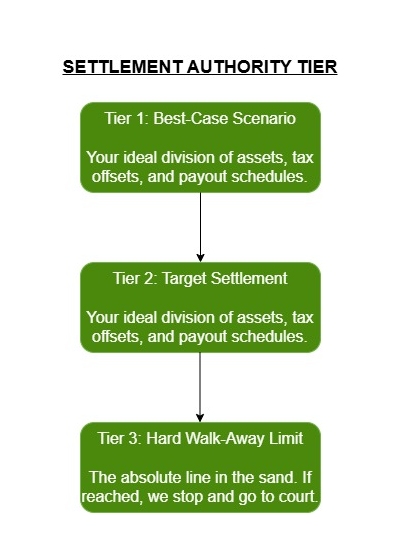
- The Trade-Off Matrix: Decide in advance what you are willing to trade. (“I will give up my claim to his 401(k) if I keep 100% of the home equity and he assumes the credit card debt.”)
- Non-Negotiables: Identify the 1–2 items that are non-negotiable (e.g., retaining sole ownership of your pre-marital family business or retaining a specific real estate property).
- The Phone-Call Protocol: Establish who you will call if a surprise offer lands outside your planned range. This might be your CPA, your business partner, your dad who may be a planned co-signer, or a trusted financial advisor. You do not make off-the-cuff financial decisions in a pressure cooker.
What retirement accounts create problems people don’t see coming?
Retirement division is full of procedural landmines. Many clients assume that writing “Wife gets 50% of Husband’s retirement” in a mediation agreement solves the issue. It doesn’t. Another favorite attempt that fails utterly is “Husband gets one-half of the marital portion of Wife’s retirement accounts,” which is not a calculation the plan administrator will perform.
Qualified Domestic Relations Orders (QDROs)
Most private-sector 401(k)s and corporate pensions require a specialized post-divorce court order called a Qualified Domestic Relations Order (QDRO) to divide the funds without triggering early withdrawal penalties or immediate tax liabilities.
The Military & Federal TSP Exception: RBCO vs. QDRO
For our clients in Jacksonville, Camp Lejeune, Cherry Point, and Fayetteville, pay extremely close attention:
- CRITICAL LEGAL FLAG: The federal Thrift Savings Plan (TSP) and military/civil service pensions are NOT divided by a QDRO. Federal retirement plans are divided under federal statutory authority using a Retirement Benefits Court Order (RBCO) governed by 5 C.F.R. Part 838.
If your attorney writes a generic mediation agreement stating that your spouse’s military TSP will be divided via a “standard QDRO,” the TSP board in Washington D.C. may simply reject the order outright. You will end up back in court spending thousands to fix language that should have been drafted correctly before mediation even began.
What happens to what we sign at mediation?
If you reach an agreement at mediation, the mediator will draft a Mediated Settlement Agreement (MSA) or a formal Memorandum of Understanding before anyone leaves the building. In our office, we predraft a consent order so that the mediation will be finished when we leave.
Is a signed mediation agreement immediately binding in NC?
Yes. Under North Carolina law, a written settlement agreement signed by both parties and properly notarized (or executed with the requisite formalities under N.C.G.S. § 50-20.1) is a legally binding, enforceable contract the second the ink dries.
You cannot wake up the next morning, suffer “buyer’s remorse,” and ask to undo the agreement because you feel you gave up too much. Unless you can prove fraud, duress, or extreme unconscionability—which is an extraordinarily high legal bar—what you sign at mediation sticks.
When you sit hours in a mediation and come to an agreement, I never let a client leave without a signed document. It is imperative that we sign a full agreement on mediation day, generally in the form of a consent order. Even if we are all remote and performing a mediation on Zoom, then we can still execute an agreement through an online notary such as notarize.com.
Financial mediation FAQ
Do I need a lawyer for financial mediation in North Carolina?
While North Carolina law does not technically force you to hire an attorney for mediation, attending financial mediation without an experienced family law attorney is extremely risky. The mediator cannot protect your legal rights or tell you if a deal is bad. Once you sign a mediated agreement, it is binding—having an attorney present ensures you don’t sign away assets or accept hidden liabilities you don’t understand.
How do I prepare for a mediated settlement conference in North Carolina?
Preparation requires gathering three years of complete financial records, completing a detailed inventory of all marital and separate property, obtaining formal appraisals for real estate and business interests, and meeting with your attorney to establish a clear settlement range and walk-away number before the mediation date.
What should I bring to an equitable distribution mediation?
You should bring your financial prep binder (or secure digital file access) containing your updated account balance statements, current mortgage payoffs, tax returns, executive compensation schedules, real estate appraisals, business valuations, and your completed Marital Property Inventory Worksheet.
How do I value assets before mediation?
Assets should be valued as of the exact Date of Separation (DOS) under NC law, using objective neutral sources: formal real property appraisals for real estate, certified business valuations for private companies, updated account statements for financial accounts, and valuation experts for complex executive compensation or pensions.
Can a financial mediation agreement be overturned in NC?
It is extremely difficult to overturn a signed, notarized mediation agreement in North Carolina. Courts uphold signed settlement agreements as valid contracts unless a party can meet the strict legal burden of proving fraud, misrepresentation, duress, or severe procedural unconscionability.
Who pays the mediator fees in a North Carolina divorce?
By default in North Carolina court-ordered mediations, the mediator’s fee is shared equally (50/50) between the parties, unless the parties agree otherwise in writing or a judge orders a different fee distribution based on financial hardship.
To take control of your financial future and enter your settlement conference with complete confidence, download the free Cape Fear Family Law Financial Mediation Preparation Worksheet—the document list, valuation checklist, and walk-away worksheet you complete with your attorney before mediation day.
Have an upcoming mediation date and need a Board-Certified Specialist to protect your assets? Schedule a confidential consultation today with Cape Fear Family Law.
Need a neutral, highly experienced certified family financial mediator both sides can agree on?
Book Janet L. Gemmell as your neutral financial mediator or Book Allie Cameron Moore as your neutral financial mediator.