
By Marion Alexander White II, Junior Associate Attorney | Cape Fear Family Law
Direct Answer
“In North Carolina, a negotiated settlement with mediation typically costs $5,000 to $20,000 across both spouses combined (roughly $2,500 to $10,000 per side). Full litigation runs $6,000 to $80,000 per side on average — and from there, the sky is the limit. Yes, you also read that correctly as at least 4x to go to court and could go as high as 10x. The difference between the two paths can be a six-figure decision.”
— Janet L. Gemmell, Board-Certified Family Law Specialist & Certified Family Financial Mediator
As an attorney, a lifelong North Carolinian, and a deep believer in protecting the integrity of the family unit, my goal is always to bring calm to the chaos. I look at family law through a highly structured, analytical lens. I am the guy who breathes a sigh of relief when a case involves massive data sets, complex spreadsheets, hidden cryptocurrency trails, and highly technical asset division.
But whether we are tracking down Bitcoin or dividing an estate, the very first choice you must make is tactical when the offers have already been shared but there is no movement: Are you going to mediate, or are you going to litigate?
Choosing the wrong path for your specific situation can easily turn into a devastating financial misstep. Let’s break down the real numbers, look past the misleading traps found on generic internet blogs, and map out exactly what each path costs under North Carolina law in 2026.

Add a brief, grounded story here about growing up in North Carolina, how your family taught you the value of a hard-earned dollar, or your routine grabbing a quiet coffee near Center City Park in downtown Greensboro before diving into a multi-million dollar RSU spreadsheet.”
— Marion Alexander White II, Junior Associate Attorney, Cape Fear Family Law
The Cost-Clarity Block: The Three Paths, Three Numbers
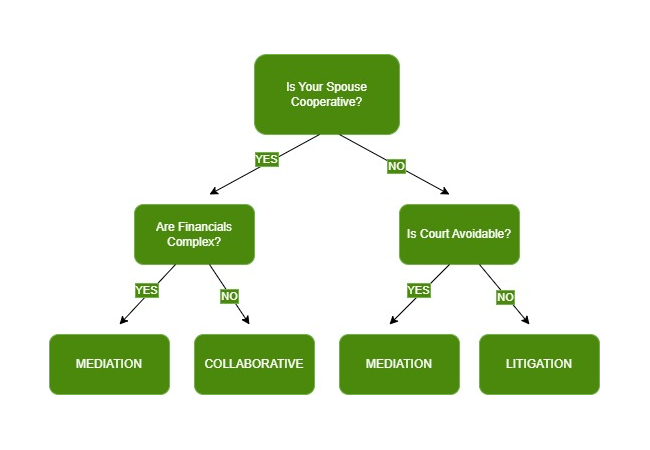
To make an informed decision, you need transparent, unvarnished numbers. When looking at the financial landscape of a North Carolina divorce, your case will generally fall into one of three distinct pricing tiers.
- The Collaborative Path
- Total Combined Cost: $4,000 – $20,000
- Estimated Cost Per Spouse: $2,000 – $10,000
- What it covers: An entirely out-of-court, contract-driven process where both spouses and their attorneys formally agree to settle without ever stepping foot inside a courtroom.
- The Negotiation and Mediation Path
- Total Combined Cost: $5,000 – $20,000
- Estimated Cost Per Spouse: $2,500 – $10,000
- What it covers: The drafting of a Separation Agreement and Property Settlement (SAPS) or engaging a formal, certified family law mediator to systematically iron out disagreements over property, support, and scheduling.
- The Litigation Path
- Estimated Cost Per Spouse: $6,000 – $40,000+
- High-Conflict / Complex Asset Baseline: $80,000+ per side
- What it covers: Filing complaints, formal discovery, temporary hearings, motions for contempt, and a full trial in front of a Guilford County District Court Judge. The ceiling is wherever you stop signing checks.

How Much Does Mediation vs. Litigation Cost in North Carolina?
The reality of family law is that “cost” is directly tied to conflict and complexity. To answer the burning question of how much mediation vs. litigation costs in North Carolina, we have to look closely at how our local legal ecosystem operates.
Many law firm blogs intentionally mislead consumers by quoting “total case costs” without specifying whether those numbers apply to a single individual or to both parties combined. Let’s be completely transparent: Every spouse must retain their own independent legal counsel. When a generic website says a divorce costs $10,000, they are often hiding the fact that each side is paying that amount, instantly doubling the true drain on the marital estate.
Our founder, Janet L. Gemmell, sums up the brutal reality of the litigation track perfectly:
“Look, if you want to let your ego make your legal decisions, get ready to pay for it. Going to court to argue over who gets the dining room table isn’t noble; it’s a form of financial self-inflicted harm. Litigation is a precision weapon meant for high-stakes warfare, not a therapy session. If you insist on dragging every minor grievance in front of a judge, don’t scream when the bill matches your level of drama.”
— Janet L. Gemmell, Board-Certified Family Law Specialist
How North Carolina Defines Each Legal Path
To understand why the price tags diverge so drastically, we must look at how North Carolina law structurally handles these competing mechanisms.
- Negotiation and Mediation (SAPS)
In NC, you do not actually have to file a lawsuit to resolve your marital issues. A Separation Agreement and Property Settlement (SAPS) is a highly customized, private contract.
Mediation can occur voluntarily before anyone files a lawsuit, or it can be court-ordered. In fact, if you file a lawsuit for equitable distribution (property division) or child custody in Guilford County, the court will actively mandate that you attend mediation before they allow you to take up space on the trial calendar.
- Full-Blown Courtroom Litigation
Litigation begins the exact moment one party files a summons and a verified complaint with the Clerk of Court. From that day forward, your life is governed by the North Carolina Rules of Civil Procedure and strict statutory deadlines. You are no longer setting the timeline; the court calendar is.
Is Mediation Cheaper Than Divorce Court in NC?
Without question, mediation is significantly more cost-effective than a trial in the vast majority of family law cases. However, as an attorney who has experience specializes in deep financial forensic work, I have to give you an honest caveat: Mediation is only cheaper if both parties are transparent.
If your spouse is completely cooperative and willingly hands over their financial records, mediation acts as a streamlined bridge to your next chapter. But if you are dealing with a spouse who is actively hiding assets, deleting digital footprints, or refusing to compromise, mediation can sometimes become an expensive, unproductive pit stop on the inevitable highway to court.
The True Cost Drivers of NC Divorce Litigation
Why does the price of a contested divorce in NC skyrocket so quickly? It is rarely because of the time spent arguing inside the physical courtroom. The real financial drain happens during the intensive preparation phases.
As an attorney with a high-detail Kolbe profile, I track these numbers meticulously. Here are the primary cost drivers that run up a litigation invoice:
High-Level Asset Division and Forensic Tracing
When a case involves sophisticated financial components, the complexity multiplies. I thrive in these environments, but they require systematic billable hours to execute correctly:
- Restricted Stock Units (RSUs) and Stock Options: Tracing vesting schedules, analyzing tax implications, and drafting specialized division orders.
- Business Valuations: When a spouse owns a business in High Point or a medical practice in Summerfield, we must bring in specialized forensic accountants to audit the books, determine true market value, and calculate normalized cash flow.
- Hunting for Bitcoin and Cryptocurrency: Tracing transactions across public blockchains, identifying cold storage hardware wallets, and analyzing exchange records to ensure digital wealth isn’t cleanly swept under the rug.

The Formal Discovery Process
In mediation, document exchange is typically voluntary. In litigation, we utilize Formal Discovery. This includes drafting and answering detailed Interrogatories, Requests for Production of Documents, and Requests for Admissions. If your spouse hands us a disorganized box containing ten thousand unformatted PDF pages of bank records, someone has to systematically audit every single line item.
Depositions
A deposition is a formal proceeding where an attorney questions a witness under oath in front of a court reporter. Depositions are exceptionally powerful tools for locking down testimony before trial, but between attorney prep time, court reporter appearance fees, and transcript generation costs, a single day of depositions can routinely run $3,000 to $5,000.
The Custody Evaluator Line Item
If child custody is deeply contested and mediation fails, either party can request, or a judge can order, a private psychological custody evaluation. These evaluations are conducted by neutral, licensed psychologists who interview the parents, observe the children, and conduct deep psychological testing.
- The Baseline Cost: This single line item routinely costs between $5,000 and $15,000, typically split between the parents up front.
Motions for Sanctions and Contempt
If a spouse actively refuses to pay court-ordered child support, or intentionally violates a temporary custody schedule, we must file formal motions for contempt or motions to compel discovery. While these steps are completely necessary to protect your children and your rights, they require drafting pleadings, filing fees, and dedicated court appearances.
ALEX’S FINANCIAL INSIGHT:
“I always had a passion for bringing things together. I enjoy how spreadsheets assist me with this passion by bringing together my client’s finances in a way that makes sense to them. My passion and experience for making financial spreadsheets saves my clients money because it cuts down on disorganized legal hours, ensuring everything is ready for a clean presentation. Whether it is in a conference room for mediation or in a courtroom, I save my clients money and give them peace of mind.”
— Marion Alexander White II, Junior Associate Attorney, Cape Fear Family Law
Mediation vs. Litigation: A Direct Comparison
To help you visualize how these two frameworks stack up across Guilford County cases, review the structural breakdown below:
| Feature / Dimension | Voluntary Mediation Path | Contested Courtroom Litigation |
|---|---|---|
| Control Over the Outcome | Total. Both spouses must agree to the terms. No one can force you to sign a contract. | Zero. A single judge makes the ultimate binding decision. |
| Privacy Levels | 100% Confidential. Discussions and financial sheets remain private corporate/legal files. | Public Record. Financial disclosures and trial transcripts are accessible to the public. |
| Average Timeline | 2 to 6 Months. Scheduled at the comfort and availability of the parties. | 12 to 24+ Months. Completely dependent on the heavy backlog of the local court calendar. |
| Forensic Capability | Dependent on voluntary transparency or targeted contractual demands. | Backed by subpoenas, depositions, and court-ordered financial audits. |
| Primary Financial Impact | Modest retainer; shared mediator fees; preserved marital estate wealth. | Rapidly depleting asset bases; multiple expert fees; high trial-prep costs. |
Frequently Asked Questions (FAQs)
What is the average cost of a contested divorce in NC?
For a standard contested divorce in North Carolina involving basic property disputes and child custody disagreements, the average cost ranges from $10,000 to $30,000 per spouse. If the case escalates to include high-asset disputes, corporate valuations, or intensive forensic tracking, costs can easily exceed $75,000 per side.
What happens if I can’t afford divorce litigation in North Carolina?
If there is a massive disparity in income between you and your spouse, North Carolina law allows a dependent spouse to petition the court to order the supporting spouse to pay their reasonable attorney fees. This is particularly common in actions for alimony, post-separation support, and child custody or support enforcement.
Can a judge order my spouse to pay for mediation fees?
Generally, the fees for court-ordered mediation are split evenly (50/50) between both spouses under local court rules. However, if a party fails to appear for a scheduled mediation session without good cause, the judge can sanction that party and order them to pay the entire cost of the mediator’s wasted time.
How do child support contempt hearings affect total divorce costs?
If a parent fails to comply with a valid North Carolina child support order, filing a Motion to Show Cause for Contempt is necessary to enforce compliance. If the court finds the non-paying parent in willful contempt, the judge can order them to pay the compliant parent’s attorney fees incurred during the enforcement action, shifting the cost burden entirely.
Secure Your Financial Future with Precision
Choosing between mediation and litigation isn’t a choice between being weak or being strong. It’s a choice between being reactive and being deeply strategic. If your marriage is ending, you cannot afford to let emotional turbulence dictate your financial choices. You need a clear strategy backed by meticulous data tracking to preserve what matters most: your children, your business equity, and your long-term sanity.
Whether we need to quietly map out a comprehensive settlement framework over a spreadsheet or systematically deploy an aggressive litigation strategy inside a Guilford County courtroom, my team is built to guide you calmly through the storm.
Ready to see exactly where your marital estate stands?
Download the 2026 NC Divorce Cost Calculator today, or schedule a comprehensive, completely confidential strategy session with our legal team.