
Direct Answer
“When parents sharing joint legal custody in North Carolina reach a deadlock over an IEP, a medical diagnosis, or a prescribed treatment, neither parent holds an automatic veto to block necessary care. Instead, parents must navigate two separate legal systems simultaneously: the educational system under federal and NC special education law, and the family court system under N.C.G.S. Chapter 50. If a co-parent’s refusal halts critical educational or therapeutic intervention, a North Carolina family court judge can modify legal custody or award final tie-breaking decision-making authority to the parent acting in the child’s best interests.”
— Melissa Jean Bradnick, Family Law Attorney at Cape Fear Family Law

As an attorney fighting for parents across Wake County, Franklin County, and Granville County, I see this deadlock frequently. Parents in this situation often feel completely trapped between a school district that refuses to move forward without both parents’ consent and a co-parent who refuses to acknowledge a professional diagnosis.
The reason most parents feel so stuck is that they don’t realize they are playing on two completely different game boards at the exact same time.
THE TWO-SYSTEM REALITY | |
|---|---|
| BOARD 1: THE EDUCATION SYSTEM | BOARD 2: THE FAMILY COURT SYSTEM |
|
|
|
|
|
|
|
|

HOW THEY INTERACT WITH EACH OTHER
A ruling or modification on Board 2 changes WHO holds decision-making authority on Board 1. Conversely, the evidence gathered on Board 1 (IEP notes, evaluations, refusals) forms the factual foundation for your motion on Board 2.
- Board One: The Education System. This board consists of the school district, the IEP team, eligibility determinations, 504 plans, and state-level special education dispute mechanisms (facilitated IEP meetings, state complaints, and Office of Administrative Hearings due process petitions). The school system runs on strict federal and state timelines. It does not resolve custody disputes; it only asks, “Who has the legal right to give consent under federal law?”
- Board Two: The Family Court System. This board consists of your local District Court judge, your custody order, and N.C.G.S. Chapter 50. Family court determines legal custody, physical custody schedules, and who holds final decision-making authority. Family court can reallocate authority on Board One when parents hit an unresolvable stalemate.
When you understand how a move on Board One impacts Board Two, you can break the stalemate and secure the support your child needs.
Imagine a client in rural North Carolina who spent six months trading speeches with their ex in school conference rooms over their child with a learning disability, as if voice volume and folding chairs were a recognized method of obtaining an IEP and getting the prescribed medication given the same way twice in a row. An attorney is really not built for that kind of theater, and neither are most parents who are already dealing with the issues necessitating an IEP. Now imagine the solution -one motion in family court put educational and medical decision-making with the parent who would actually use it, and the school, to its credit, stopped hosting the custody show and started implementing the plan.

Who has the authority to make educational decisions when parents share legal custody?
Under North Carolina law, joint legal custody means that both parents share the legal right and responsibility to make major decisions affecting their child’s welfare. Major decisions typically fall into four primary categories:
- Educational decisions (IEPs, 504 plans, school placement, tutoring, testing)
- Healthcare decisions (medical diagnoses, surgeries, prescription medications, specialists)
- Mental health decisions (therapists, psychologists, counseling, psychiatric care)
- Religious upbringing and major extracurricular commitments
When a court decree or separation agreement awards “joint legal custody” without any additional qualifications, neither parent’s decision legally overrides the other. If the order is silent on how to break a tie, both parents hold equal decision-making power.
Federal Special Education Law vs. NC Custody Orders
Under the Individuals with Disabilities Education Act (IDEA) and federal regulations (34 C.F.R. § 300.30), a “parent” includes a biological or adoptive parent who is legally authorized to make educational decisions. However, when parents are divorced or separated, federal special education law generally defers to the specific provisions of the governing state court custody order.
If a North Carolina custody order explicitly assigns educational decision-making authority or “tie-breaking power” to one parent, the school district must honor that order and take direction from that designated parent. If the custody order simply states “joint legal custody” without a tie-breaker, school administrators are usually legally advised by their school board attorneys not to take sides or proceed with contested non-emergency services over an objecting joint custodian’s refusal.
What if my co-parent refuses to sign the IEP or consent to an evaluation?
When a child exhibits signs of learning disabilities, speech impairment, autism spectrum conditions, or ADHD, the first step in the school system is requesting an initial special education evaluation. Under federal and North Carolina special education rules, informed parental consent is mandatory before a school district can conduct an initial evaluation or provide initial special education services.
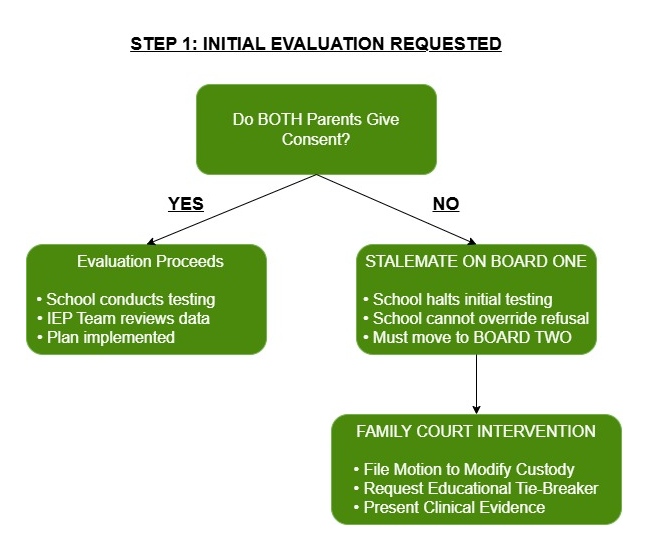
Initial Evaluation vs. Existing IEP Re-evaluation
It is vital to distinguish between an initial evaluation and an existing, ongoing IEP:
- Initial Evaluations & Initial Service Placement: If your co-parent refuses to sign the consent form for an initial evaluation or initial placement into special education, the school district will almost never proceed. The school district cannot force an initial evaluation over a parent’s active refusal unless the district itself files a due process petition against the parents—a rare occurrence.
- Annual Reviews & Existing IEPs: If your child already has an active IEP in place and your co-parent simply refuses to sign the annual review or updated IEP document, North Carolina special education rules generally allow the school to continue implementing the existing IEP (or implement the proposed changes after proper prior written notice), unless a parent formally files for a due process hearing to contest the changes.
If your co-parent’s refusal to consent to an initial evaluation is halting necessary educational testing, staying on Board One will get you nowhere. You must bring the issue to Board Two (family court) to ask a judge to grant you the sole legal authority to consent to educational and psychological evaluations.

What if my co-parent refuses to give prescribed medication during their parenting time?
One of the most agonizing conflicts occurs when a licensed physician, pediatrician, or psychiatrist diagnoses a child with a medical condition (such as ADHD, clinical anxiety, or depression) and prescribes daily medication, but your co-parent refuses to administer the medication during their physical custody time.
The Legal Framework Around Medical Administration
A parent with joint legal custody cannot unilaterally override a treating physician’s medical prescription. However, enforcement across two households is legally complex:
- You Cannot Force Medication Administration Inside Their Home Without a Specific Court Order: A school nurse can administer medication during school hours pursuant to a doctor’s order and signed school administration forms. But during a co-parent’s weekend or custodial time, you cannot physically force them to administer a pill unless your court order explicitly mandates compliance with prescribed medical regimens.
- Documenting the Impact on the Child: If a co-parent unilaterally halts prescribed daily medication every Friday through Sunday, the child often experiences severe biological and emotional disruption—commonly known as “rebound effects”—when returning to school or your home on Monday.
- Involving the Treating Provider: If a co-parent’s refusal to administer prescribed medication creates genuine medical risks, withdrawal symptoms, or extreme developmental regression, your first call must be to the child’s treating medical provider to report the non-compliance and seek clinical guidance. Your second call should be to your legal counsel.
Note & disclaimer: As legal advocates, we do not provide medical advice or evaluate clinical appropriateness. Our role is to build a legal evidentiary record based on the official recommendations of your child’s treating medical professionals.
The courtrooms in Wake, Franklin, and Granville counties are not sentimental about Monday mornings. When a parent walks in with teacher logs and doctor notes that line up the same way every week (for example: child comes back from an unmedicated weekend visit, and by first period the work is sloppy, the behavior is off, and the teacher is writing the same paragraph she wrote last Monday) the court does not ask everyone to hug it out in a conference room. Judges in these halls have seen the pattern often enough that they treat it as a record, not a vibe.
I like a record. I am not interested in who gave the better speech at the IEP table. I am interested in whether the logs, the clinic notes, and the Monday work samples say the same thing without anyone having to raise their voice. When that packet is clean, these courts move. They will tighten decision-making, they will order the medication administered as prescribed, and they will stop pretending that “we just disagree about parenting styles” is a complete answer to a child who cannot function after two unmedicated days. It’s my opinion that the judges in Wake, Granville, and Franklin counties care about suffering children and just want to help when parents are in conflict.
The IEP piece is the same problem in a nicer font. One parent blocking evaluations, refusing to sign, or turning every eligibility meeting into a custody hearing does not freeze the child’s needs. It just delays the services and creates a second paper trail: the school documenting who showed up, who stonewalled, and how long the child sat without the plan the other parent was trying to put in place. That file does not get less ugly with time. The child remains hurting and in limbo while one parent stonewalls.
The parent who blocks treatment likes to think they are holding a principle. They truly believe their position and often without a second medical opinion to back them up. What they are actually holding is the future exhibit list. Courts in my counties are not subtle once the decline is documented and the obstruction is obvious. The parent who kept the child off the medication and off the IEP becomes the parent who has to explain, later, why the child’s grades, behavior, and medical compliance all improved the minute one adult was allowed to follow the doctor’s orders and the school recommendations.
I have no talent for the six-month conference-room tour. File the motion, attach the logs, attach the notes, and let the Monday pattern do the talking. The blocking parent can keep the speech. The court, in my experience, keeps the child on the plan.

What if one parent doesn’t accept the diagnosis at all?
Diagnostic denial is extraordinarily common. It frequently sounds like:
- “He’s just being a lazy boy; he doesn’t have ADHD.”
- “She just needs more discipline at my house; she isn’t autistic.
- “Therapy is just brainwashing my child to turn against me. Anxiety for a child this age is not a real thing and only happens at the other parent’s house.”
Under North Carolina law, when determining custody and legal decision-making authority under N.C.G.S. § 50-13.2, the court’s sole governing standard is the best interests of the child.
How Judges Evaluate Diagnostic Denial
North Carolina District Court judges are not medical doctors, but they rely heavily on objective, credentialed third-party experts. When evaluating a parent who completely rejects an established clinical diagnosis, judges look at:
- Expert Credibility: Reports and testimony from neutral, licensed professionals (neuropsychologists, pediatric developmental specialists, school psychologists, licensed clinical mental health counselors).
- Child’s Functional Performance: Academic report cards, standardized testing data, behavioral incident reports from school, and therapy progress notes.
- Parental Capacity: A parent’s willingness to acknowledge reality and adapt their parenting strategies to meet the child’s demonstrated needs. A parent who stubbornly denies documented clinical diagnoses out of spite or personal bias risks losing legal decision-making authority to the parent who actively follows expert recommendations.
What can the school do, and what can’t the school do, when parents disagree?
School personnel—teachers, guidance counselors, principals, and IEP facilitators—are educators, not domestic relations judges. When caught in the middle of high-conflict co-parenting disputes, public school districts in North Carolina must follow strict boundaries.
When a school district reaches an absolute legal impasse due to conflicting parental instructions, they will simply notify both parents in writing that special education processes are frozen until the parents provide a clarified court order or a signed, notarized agreement.
What dispute options exist inside the school system before I go back to family court?
Before rushing directly into a family court trial, you should understand the state-level dispute resolution mechanisms available on Board One. The North Carolina Department of Public Instruction (NCDPI) Exceptional Children Division provides four distinct dispute resolution avenues:
1. Facilitated IEP Meeting (FIEP)
A impartial, state-trained facilitator attends the IEP meeting to manage communication, keep discussions focused on the child’s needs, and help high-conflict team members reach consensus. This service is free to parents and schools.
2. Formal Special Education Mediation
NCDPI provides neutral, trained mediators to assist parents and school personnel in resolving special education disagreements. If the parties reach an agreement, it results in a legally binding written agreement enforceable in state or federal court.
3. Formal State Complaint (NCDPI)
If you believe the school district has violated state or federal special education law (such as failing to implement an existing IEP or failing to follow required timeline protocols), you can file a written State Complaint with NCDPI. DPI investigates and issues a written decision within 60 days.
4. Due Process Petition (Office of Administrative Hearings – OAH)
A formal administrative lawsuit filed with the NC Office of Administrative Hearings. An Administrative Law Judge (ALJ) hears evidence and issues a binding decision regarding the child’s identification, evaluation, educational placement, or provision of a Free Appropriate Public Education (FAPE).
While these options are powerful tools for resolving disputes between parents and the school district, they do not empower DPI or an ALJ to strip a recalcitrant co-parent of their joint legal custody rights. If the primary cause of the deadlock is your co-parent’s refusal to consent, Board Two (family court) is the only venue that can permanently solve the problem.
When do I ask a judge to give one parent final decision-making authority?
When a co-parent’s unreasonable refusal or diagnostic denial threatens your child’s academic, physical, or emotional development, you must ask a family court judge to step in.
The Legal Standard: Modifying Legal Custody in NC
Under N.C.G.S. § 50-13.7, to modify an existing custody order, you must establish two critical legal elements:
- There has been a substantial change in circumstances affecting the welfare of the child since the entry of the last custody order.
- Reallocating decision-making authority or modifying custody is in the child’s best interests.
Under established North Carolina case law (including Diehl v. Diehl and MacLagan v. Klein), an unresolvable breakdown in parental decision-making and communication that harms or halts a child’s essential medical or educational care constitutes a substantial change in circumstances.
TYPES OF COURT-ORDERED RELIEF IN NC | |
|---|---|
| OPTION A: Educational & Medical Tie-Breaking Authority | Retains joint legal custody overall. Requires parents to consult in good faith first Grants ONE parent final decision-making power if deadlock occurs |
| OPTION B: Carved-Out Sole Legal Custody | Grants one parent exclusive authority over specific areas | (e.g., Sole Educational Custody or Sole Medical Custody). |
| OPTION C: Full Sole Legal Custody | Reallocates ALL major life decision-making authority | to one parent across all domains. |
Experience tells us that judges in Wake, Franklin, and Granville counties frequently prefer Option A (Tie-Breaking Authority) because it preserves the co-parent’s right to be informed and consulted while eliminating their ability to paralyze critical care for the child.
How do I document this the right way?
When you walk into a North Carolina courtroom to ask a judge for final decision-making authority, broad assertions like “My ex is being unreasonable” will not win your case. You need an airtight, objective paper trail that demonstrates a pattern of bad-faith refusal versus your consistent commitment to your child’s needs. It must be in the best interests of the minor child.
The 5-Step Documentation Protocol
Step 1: Use Written Communication Exclusively
AppClose, OurFamilyWizard, or professional email. Stop phone calls/verbal chats.
Step 2: Present Professional Recommendations Clearly
Attach official medical doctor notes, IEP recommendations, or evaluation reports.
Step 3: Make Direct, Timed Requests for Consent
“Please confirm in writing by Friday at 5 PM if you consent to the testing.”
Step 4: Log the Consequences of Refusal or Delay
Document missed school support, delayed therapy, or academic regression logs.
Step 5: Maintain a Centralized Co-Parenting Journal
Keep a chronological log combining school emails, medical records, and app messages.
- Move All Communications to Writing: Use co-parenting platforms like AppClose or OurFamilyWizard, or stick strictly to email. Do not rely on unrecorded phone calls or verbal doorstep conversations.
- Present Professional Recommendations Clearly: Frame your requests around expert guidance: “Dr. Smith has recommended a speech language evaluation based on Sarah’s latest milestone assessment. Attached is her written referral. Please review and let me know if you consent by Friday.”
- Set Clear, Reasonable Deadlines: Give your co-parent a reasonable timeframe (e.g., 5 to 7 business days) to respond in writing.
- Log the Tangible Impact on the Child: Keep detailed records of teacher feedback, missed therapy sessions, report card grades, and behavioral observations. Show the court the direct connection between your co-parent’s delay and your child’s struggle.
- Never Engage in Hostile Language: Keep your written messages calm, child-focused, and professional. Assume every single message you send will be printed out and read aloud to a District Court judge.
Attorney Janet L. Gemmell told me about a time she walked into a contested legal-custody trial with a parent who had done the unfashionable (cough “boring) thing after months of unresolved conflict: every OurFamilyWizard message printed, dated, and indexed in chronological order, no speeches, no highlighter tantrums. She told me, “the child was in seventh grade with an IEP for high-functioning autism, and the binder did not argue about who loved the child more. It showed, page after page, who answered the school, who followed the plan, and who used the app like a stage. The other side arrived with feelings.” The court, to its credit, reviewed all the evidence even for a temporary hearing and made a great order. The Court resolved the conflict with the care of the minor child solely in mind.
IEP and medical decision-making FAQ (North Carolina)
What happens when parents disagree about an IEP in North Carolina?
When parents with joint legal custody disagree about an IEP, the school district cannot take sides or resolve the custody dispute. For initial IEP placements or initial evaluations, the school generally cannot proceed without both parents’ consent or a court order granting one parent educational decision-making authority. For annual reviews of existing IEPs, the school may proceed with the proposed plan after providing Proper Prior Written Notice, unless a parent files a formal due process petition or seeks a court injunction.
What can I do if my co-parent won’t sign the IEP?
If your co-parent refuses to sign consent for an initial IEP evaluation or service plan, you should document their refusal in writing, request a Facilitated IEP meeting through NCDPI, and consult with a family law attorney to file a Motion to Modify Custody in NC District Court to seek educational tie-breaking decision-making authority.
Can one parent refuse an ADHD medication during custody time?
A parent cannot unilaterally alter or stop a child’s doctor-prescribed medication without legal risk. However, enforcing compliance during the co-parent’s personal parenting time requires a specific court order mandating adherence to prescribed medical treatments. If a co-parent’s refusal endangers the child’s health or academic stability, you should contact the treating physician and petition the family court for relief.
Can one parent refuse a special education evaluation or diagnosis?
Under federal special education law, initial evaluations require parental consent. If a joint legal custodian actively refuses consent, the school district will freeze the evaluation process. To unfreeze the process, the parent seeking the evaluation must petition a North Carolina family court judge to allocate final educational decision-making power to them.
What happens if parents disagree about therapy for a child in NC?
Therapy and mental health treatment fall under healthcare decisions in joint legal custody. Most licensed therapists in North Carolina will not treat a minor child without the consent of both joint legal custodians, or a court order granting one parent the legal right to consent to mental health treatment. If your co-parent refuses necessary therapy, you must petition the court for medical decision-making authority.
Who makes medical decisions with joint legal custody in North Carolina?
With standard joint legal custody, both parents must consult and agree on major medical decisions, diagnoses, and treatment plans. If parents reach a persistent deadlock, neither parent has inherent overriding authority unless the custody order explicitly includes a medical tie-breaker clause or allocates sole medical decision-making authority to one parent.
Download the free guide: When One Parent Disagrees — IEP, Diagnosis, Medication & Treatment. A step-by-step decision tree, a documentation log, and the exact written requests to send.
Stuck between a school that won’t act and a co-parent who won’t agree?
Schedule a consultation today with Cape Fear Family Law: