
DIRECT ANSWER
“In North Carolina family law cases, you should preserve publicly available posts, screenshots of communications you are a party to, your own lawful-access location data, and footage from front door cameras. You may NOT install spyware, log into accounts that aren’t yours, secretly record conversations you are not part of, install secret cameras in your home (especially in bedrooms or bathrooms), or pull GPS data from devices you don’t own — each can be a federal or state crime and can render your evidence inadmissible and you in jail.”
— Janet L. Gemmell, Board-Certified Family Law Specialist


In North Carolina family law, how you gather digital evidence matters just as much as what that evidence reveals, and sometimes even more. Unlawfully captured text messages, illegally installed GPS trackers, or covert spyware can do far more than destroy your divorce or child custody case, sometimes it can land you in a criminal courtroom facing state or federal felony charges.
This guide breaks down the precise line between lawful digital evidence gathering, state and federal criminal surveillance, and what NC family court judges actually care to look at.
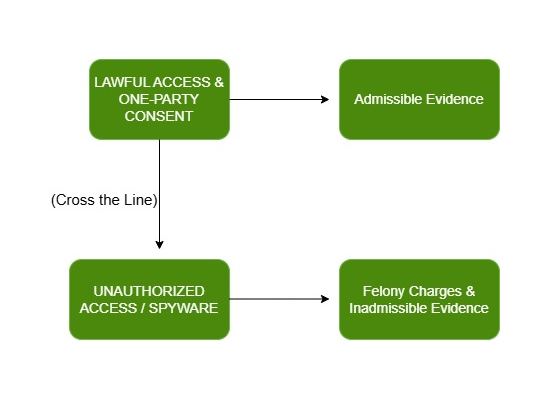
The Single Line in the Sand: Party, Owner, or Lawful Access?
To determine whether a piece of digital evidence is usable in a North Carolina family law case, judges, attorneys, and law enforcement evaluate three core questions:
- Are you a direct party to the communication?
- Do you own or have primary operational authority over the device or account?
- Do you have explicit, lawful permission to access the data?
If the answer to all three questions is “no,” you are stepping directly out of family court strategy and into criminal statutory violations. Call your attorney to see what you should do to gather the information you know exists. Do not forget that “fruit of the tainted tree” is a real problem for your legal case. Talk to your attorney before you confront your opposing party with evidence to make sure you obtained the evidence it fairly and legally.
The Legal Side of the Line: What You Can Lawfully Capture
You have every right to preserve digital evidence that flows directly to you or exists in the public domain. Lawful digital evidence gathering in North Carolina includes:
- Your Own Text Messages and Call Logs: Screenshots, exports, or records of text conversations, iMessages, WhatsApp chats, or call histories between you and your spouse.
- Public Social Media Content: Posts, public stories, photos, live streams, and comments published on non-private social media profiles (Facebook, Instagram, TikTok, LinkedIn, X).
- Your Own Account and Location Data: GPS logs, Google Maps timeline data, or app-location histories attached to your personal device or an account registered solely in your name.
- Security Cameras Inside Your Own Residence: Video footage captured by cameras installed in common areas of a home you currently occupy and legally control (e.g., living room, driveway, entryways).
Clients have a ton of text messages between themselves and the other parent. I have referenced in my own social media videos that parents should never send a negative text message. My client April (name changed for confidentiality) brought in a massive stack of lawful text screenshots showing a pattern of toxic co-parenting. Her child’s father (commence your own baby daddy jokes here) called her names, cussed at her, told her she was stupid, and said horrible things. I remember clearly he wrote her in one text, “Witchy B*tch, I will come over anytime I want to pick up our son and he’ll learn how to use his package on a woman so she shuts up and learns her place, unlike his stupid ignorant ho of a momma.” Little doubt at what happened at the custody trial, right? Supervised visitation with a side of mandatory counseling and parenting classes were in his future.
Meanwhile, limited and business-like text messages between parents about the time, location, and place of exchanges and child related events, show to the court the quality of each parent. Remain calm in all text messages. Provide your attorney organized documentation and downloaded text messages because that is what wins cases over emotional rants. Modern tech makes or breaks credibility in courtrooms in all counties of North Carolina. From Mecklenburg County through New Bern, North Carolina, good parenting is easy to spot.
Crossing into Criminal Territory: What Will Get You Disqualified or Indicted
When clients let anger or suspicion drive their evidence gathering, they often cross into illegal surveillance. The following actions are almost universally unlawful under North Carolina and federal law:
- Installing Spyware or Stalkerware: Secretly downloading monitoring apps (such as mSpy, FlexiSPY, or keyloggers) onto your spouse’s phone or laptop.
- Unauthorized Account Access: Guessing passwords, using stored credentials without permission, or resetting passwords to access your spouse’s private email, cloud storage (iCloud/Google Drive), or social media DMs.
- Secret GPS Tracking on Unowned Vehicles: Magnetically attaching an Apple AirTag, Tile, or dedicated GPS tracker to a vehicle that is titled solely to your spouse or used exclusively by them after separation. When in doubt, hire a private investigator.
- Eavesdropping on Third-Party Conversations: Secretly recording oral or digital communications between your spouse and a third party (including your children or their alleged paramour) when you are not a participant in the conversation.
Back in 2012, ABC News reported on feuding couples using spy gadgets to snoop and in the article noted specifically, “One of the primary reasons do-it-yourself snooping has become more widespread is because it is relatively cheap and easy. Surveillance equipment can cost less than $300, and spy gear that can’t be found in a store can be bought online. Some recording devices are small enough to be mounted on a keychain, a motel room peephole, eyeglasses, pens or even inside a child’s favorite toy.” Guess what, nothing has changed in 14 years except the technology is getting better and people are getting sneakier.
Recently the Court in a number of our cases disciplined parents that recorded their children in numerous custody cases. In one case, a parent recorded their child claiming sexual abuse against the other parent. The video was the non-accused parent interrogating the child. But that was not all she did, the mom in this case actually sent hidden recording devices in the minor child’s bookbag trying to catch things dad was saying and doing. Of course, this was illegal activity and even though it was not reported to law enforcement, mom’s behavior did not escape the judge’s wrath.
In another recent case, a wife put tracking and recording devices in her husband’s vehicle, which was titled totally to him. She recorded him cheating with an unknown man, but the Court refused to use the evidence at all, not even to impeach the husband who lied about the behavior in his discovery responses, etc. The Court appeared to question wife’s character and wanted to know from the attorneys why a private investigator was not hired versus the “self-help” illegal method wife utilized. Simply put, it would have been worth the fee to the private investigator to ensure wife did not get charged criminally or for her to be able to use that information at trial, since cheating by the supporting spouse locks in and obligates alimony payments (and keeps wife’s character above reproach).

Federal and North Carolina Laws Protecting Digital Privacy in Divorce
If you capture digital evidence illegally, North Carolina courts will not simply “ignore the mistake.” Opposing counsel will file motions to suppress the evidence, seek monetary sanctions, and refer the matter to the local District Attorney or federal prosecutors.
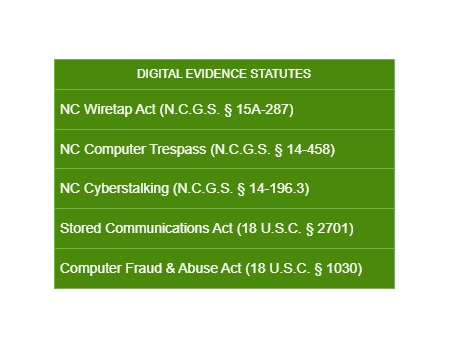
North Carolina Wiretap Act (N.C.G.S. § 15A-287)
North Carolina is a one-party consent state for audio recordings. This means you can legally record an in-person or telephone conversation if you are an active participant in that conversation. However, if you leave a voice recorder under a car seat or record two other people talking without the consent of at least one participant, you have committed a Class H felony under N.C.G.S. § 15A-287. Yes, a felony. Read it again … felony.
North Carolina Computer Trespass Statute (N.C.G.S. § 14-458)
It is illegal to access or cause to be accessed any computer, computer network, or electronic system without authorization. Logging into your spouse’s laptop or cloud account using their password without explicit permission constitutes computer trespass, which ranges from a misdemeanor to a felony depending on financial injury or intent.
North Carolina Cyberstalking & Unlawful Tracking (N.C.G.S. § 14-196.3)
It is a Class 2 misdemeanor in North Carolina to knowingly install, place, or use an electronic tracking device (such as an AirTag or GPS unit) to track the location of another person without their consent on a vehicle or property they control.
Federal Statutes: SCA and CFAA
- Stored Communications Act (SCA) (18 U.S.C. § 2701 et seq.): Prohibits unauthorized access to stored electronic communications (like unread emails or private cloud backups).
- Computer Fraud and Abuse Act (CFAA) (18 U.S.C. § 1030): Criminalizes intentionally accessing a computer without authorization to obtain protected information.
Is Ring Camera Footage and Life360 Location Data Admissible in NC Family Court?
Modern smart homes and family safety apps generate mountains of data. Understanding how judges treat smart-home surveillance and location-tracking apps is essential for building a clean trial strategy.
Smart-Home Video: Doorbell Cams, Ring, and Nest
Doorbell cameras and security cameras inside common residential areas are generally admissible, but context and location are critical:
- Admissible Use: Outdoor Ring footage showing a spouse showing up intoxicated for child exchange, bringing an unauthorized third party to the marital residence in violation of a court order, or committing domestic destruction of property.
- Inadmissible & Unlawful Use: Cameras secretly placed in areas where an individual has a reasonable expectation of privacy—such as bathrooms, guest bedrooms, or inside a spouse’s new post-separation residence.
Location Apps: Life360, Apple Find My, and AirTags
Location-tracking evidence is heavily scrutinized in custody and spousal support proceedings:
- Life360 / Family Sharing: If both spouses voluntarily joined a shared family circle (like Life360 or Apple Family Sharing) prior to separation, historical location logs pulled from your own account dashboard are generally admissible to establish patterns of behavior or co-location.
- Hidden Tracking (AirTags / GPS): Placing an AirTag inside a spouse’s purse, golf bag, or vehicle trunk post-separation violates N.C.G.S. § 14-196.3. Evidence obtained through this method will be excluded under statutory exclusionary rules and can trigger immediate domestic violence protective order (DVPO) filings.
Can You Search Your Child’s Phone or Shared Family iCloud in a Custody Battle?
The intersection of parental rights, children’s privacy, and shared digital accounts creates significant gray areas in family law litigation.
Parental Vicarious Consent vs. Minor Privacy
Parents generally have the legal right to monitor, inspect, and manage electronic devices owned by or provided to their minor children. Under the legal doctrine of “vicarious consent,” a parent can sometimes consent on behalf of a young child to record or inspect communications to protect the child’s welfare.
However, courts draw a strict line:
- Legitimate Protective Concern: Inspecting a child’s device to protect them from abuse, neglect, or exposure to inappropriate conduct is legally defensible.
- Subterfuge for Spousal Surveillance: Using a child’s device as a back door to read the other parent’s personal text messages, log into the other parent’s linked cloud accounts, or secretly record the other parent during parenting time is deeply disfavored by judges and frequently penalized in custody rulings.
Shared Family Plans and Joint Cloud Drives
If you share an iCloud account, Amazon Prime account, or Google Photos drive with your spouse:
- Data synced to a genuinely shared drive accessible by both parties during the marriage may be accessible, but downloading private communications after separation can breach statutory privacy limits once authorization is revoked.
- If your spouse changes their password or signals that access is revoked, attempting to bypass security controls—even on a shared family plan—violates state computer access laws.

How to Preserve Digital Evidence So a NC Judge Will Actually Use It
North Carolina trial judges are cautious about digital evidence. Screenshots can be fabricated, modified, or taken out of context. To get digital evidence admitted under North Carolina Rule of Evidence 901 (Authentication), you must establish its authenticity, completeness, and chain of custody.
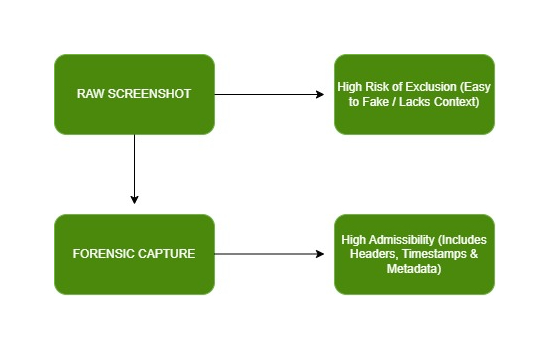
Steps for Lawful, Admissible Digital Evidence Preservation
- Capture Complete Screenshots with Context: Do not crop out battery bars, network indicators, contact names, dates, or timestamps. Capture the full conversation thread leading up to and following the key statement.
- Export Native Files and Metadata: Where possible, export thread logs directly to PDF or native format (e.g., .eml files for email, .vcf or full carrier logs for SMS). Ensure EXIF metadata (embedded time, location, and device data) remains intact on digital photos.
- Obtain Certified Carrier Records: Request official call detail records and text message transmission logs from cellular service providers via subpoena or formal discovery requests.
- Maintain a Detailed Evidence Log: Record the date, time, device used, and method of capture for every piece of digital evidence preserved.
Digital Capture Methods Matrix: Legality & Admissibility in NC
The following matrix summarizes common methods of capturing digital evidence in North Carolina family law proceedings:
Frequently Asked Questions About Digital Evidence in NC Divorce
Is it legal to screenshot my spouse’s texts in NC?
Yes, it is entirely legal to screenshot text messages sent directly to your device or sent within a group thread that includes you. Because you are a party to the communication, you have lawful access to the messages. To ensure admissibility in court, capture complete conversation threads that display the sender’s phone number or contact header, alongside full date and time stamps.
Can I use Life360 data in a NC custody case?
Yes, Life360 or Apple Find My location data can be used in North Carolina custody cases if the account was established mutually and you accessed the location data legally through your own authorized user profile. Location logs can help corroborate or refute claims regarding travel times, missed custody handoffs, or presence at unapproved locations. However, if you secretly log into your spouse’s private account after separation to track them, that data becomes inadmissible and exposes you to legal sanctions.
Is Ring camera footage admissible in NC family court?
Yes, Ring camera and video doorbell footage is routinely admitted in North Carolina family court to document custody exchanges, property damage, or domestic disturbances. Because outdoor entryways and driveways do not carry an expectation of privacy, footage captured by property-mounted cameras is lawful. To introduce Ring footage in trial, you must provide the raw video file, preserve the embedded metadata, and verify the time and date of the recording.
What happens if I put spyware on my spouse’s phone in NC?
Installing spyware, keyloggers, or hidden tracking software on a spouse’s phone is a crime in North Carolina under the NC Wiretap Act (N.C.G.S. § 15A-287) and Computer Trespass laws (N.C.G.S. § 14-458), as well as federal wiretap statutes. Any evidence obtained through spyware is strictly inadmissible in family court. Furthermore, the spouse who installed the spyware faces potential felony charges, mandatory payment of opposing attorney fees, and severe loss of credibility with the judge in custody and financial rulings.
How do I prove digital evidence is authentic in a North Carolina court?
Under North Carolina Rule of Evidence 901, you prove digital evidence is authentic by demonstrating that the evidence is what you claim it to be. This requires showing a clear chain of custody, providing unedited files containing native metadata, cross-referencing screenshots with official cellular carrier billing statements, or presenting witness testimony from the individual who captured or received the transmission.
Take Control of Your Digital Strategy Today
Navigating digital evidence in a divorce or custody dispute requires technical precision and experienced legal counsel. One wrong move can turn valuable evidence into a legal liability.
Protect your rights and secure your family’s future with our actionable digital evidence resources:
- Download the Homewrecker Evidence Guide
- Learn exactly how to audit your digital privacy, disconnect shared family accounts safely, and archive text messages for your legal team without violating state or federal privacy statutes.
Ready to discuss your case directly with an expert? Schedule a Confidential Consultation with Board-Certified Family Law Specialist Janet L. Gemmell at Cape Fear Family Law Today.